Three PMs and One Honest Conversation About Jobs in AI.
A lot’s to be said about how AI is changing the very definition of jobs in tech. From threads of panic and excitement on Reddit to early-stage AI founders being uncertain themselves on who to hire or what to look for — it’s created a ripple effect of uncertainty whose only constant seems to be adaptability.
The best way to draw patterns is to look at how people within an industry, at different stages in their career, have navigated this chaos into something intentional and meaningful.
That’s exactly what we did during our last panel discussion at Women in Product India: a deep dive into The AI Product Manager Hiring Playbook (which I was grateful to moderate!) featuring three enterprising women at very different stages of their careers.
The more I spoke to them, the more I found myself decoding a deeper, more human aspect of the hiring playbook — one that doesn’t show up in prep docs or interview notes.
1. Adaptation
If there was one thing all three agreed on, it was that AI has flattened the shelf life of expertise.
Gunjan spoke about how you can’t treat learning as an event anymore — it’s a loop. Every few months, a new model or framework changes how product work gets done, and she’s learned to build “micro-learning sprints” into her week just to stay current.
Bhavika shared how that meant even hiring managers are adapting. “We’re no longer looking for ten years of experience,” she said, “we’re looking for ten proof points of curiosity.”
And Rachna, who recently transitioned into a PM role from a different domain, put it best: “Half my prep was just unlearning how to present myself. Earlier it was about expertise. Now, it’s about agility.”
Adaptation, in that sense, wasn’t just about new tools. It was about constantly re-shaping how you see yourself in a shifting landscape.
2. Evaluation
We also spoke about how evaluation — both of candidates and companies — has completely changed shape.
Gunjan noted that hiring loops are getting shorter, faster, and sharper. We all agreed that AI moves too quickly for three-month processes. If you’re ready, you can be onboarded within weeks.
Bhavika added a layer from the hiring side: “It’s less about whether you know every metric, more about how you approach ambiguity.”
That line stayed with me — because it echoed something I’ve noticed across the board: everyone’s testing for how you think, not what you know.
Rachna brought in the other side, the candidate’s view by talking about how she’s started evaluating the process itself: “If the interview feels chaotic, that’s often a preview of what the work will feel like.”
That’s such a powerful reframing: evaluation runs both ways.
3. Agency
The most underrated part of any hiring story is agency. Knowing when to say no.
Rachna talked about turning down offers that didn’t feel right: “Sometimes the culture didn’t match. Sometimes, I just didn’t feel heard in the process.”
Gunjan nodded at that, adding that she now pays attention to how companies make decisions in the interview: If it’s all gut and no structure, that tells you how they’ll build products too.
Bhavika summed it up beautifully: Having a life story for your career is a good anchor on what path to take and not to.
That conversation reminded me that saying no is also a strategy — one that requires self-awareness and patience, especially in a market that glorifies speed.
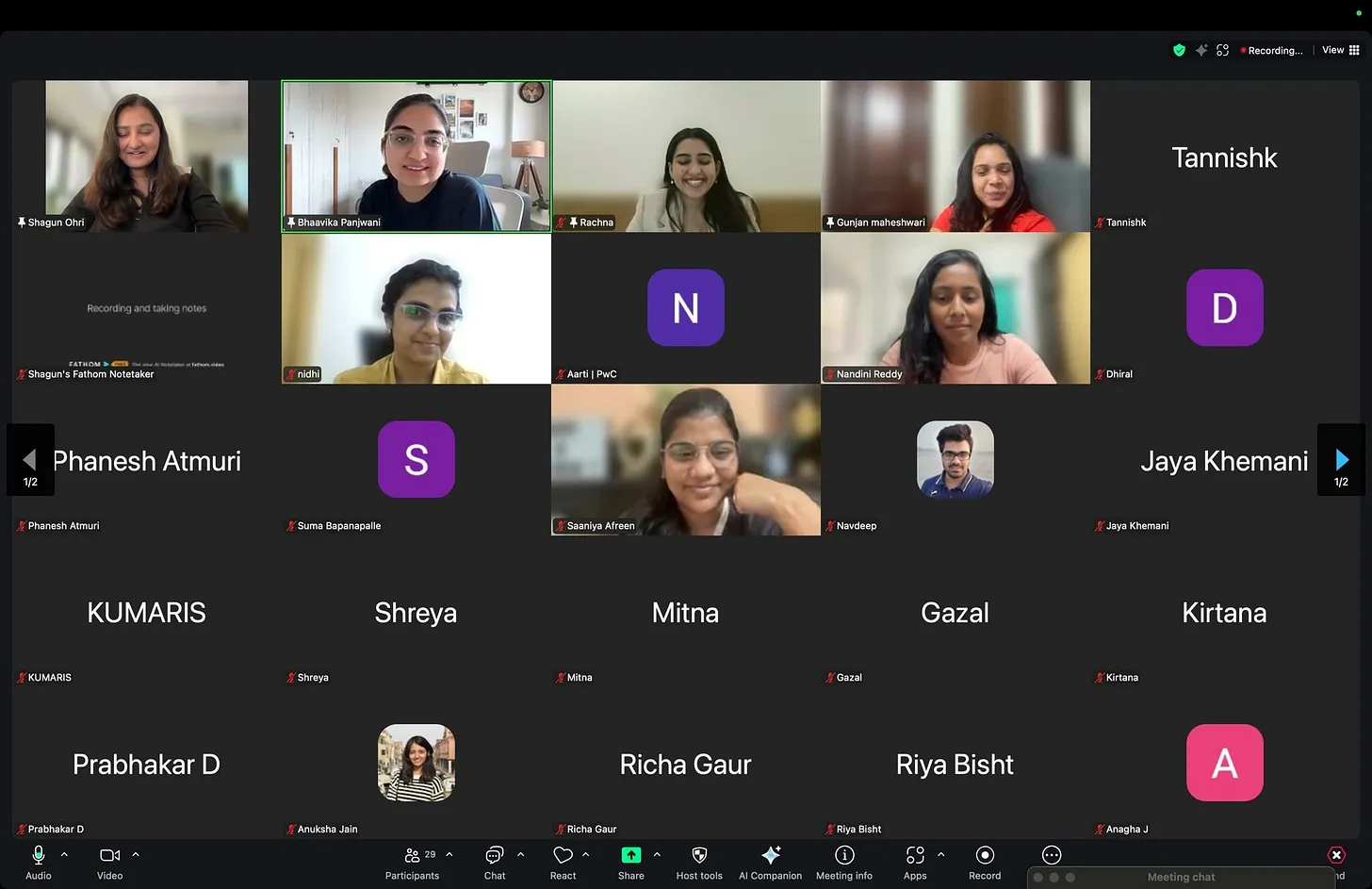
130 minutes of yap time later.
What struck me most was how little of this conversation was actually about AI. It was about adaptability, discernment, and the kind of quiet confidence that comes from learning in public.
It was also a note that for anyone building in product, the hiring playbook is rarely linear — it’s layered with personal growth, resilience, and the ability to navigate uncertainty with grace.
Moderating this session reminded me that the best guides aren’t written by experts, they’re written in real time by people figuring it out together. And that’s the honest story of women in product right now: not about keeping up with AI, but about shaping what it means to build with it.
Grateful to Swati Awasthi and Women in Product India for always enabling the best conversations and building such a phenomenal women-led community. It’s with intention we change the world for ourselves.
